The Superintelligence Roadmap: Engines, Timelines, Alignment
Definitions precise enough to argue about, engines measurable enough to track, timelines honest enough to update — and the alignment bottleneck we must solve first.

Everyone in the AI industry now says the word superintelligence. Lab chiefs put it in mission statements, senators put it in bill titles, and traders price it into chip stocks. Yet almost nobody using the word agrees on what it actually denotes, which architectures could produce it, or when — if ever — it will arrive. This dispatch lays out the roadmap the way SIERA Labs reads it: the competing definitions, the three engines that could drive an intelligence explosion, why serious forecasts span from this decade to the next century, and the alignment bottleneck that will decide whether the outcome is flourishing or catastrophe. Superintelligence, timelines, and alignment are not three separate debates. They are one debate, and it is already underway.
What Superintelligence Actually Means
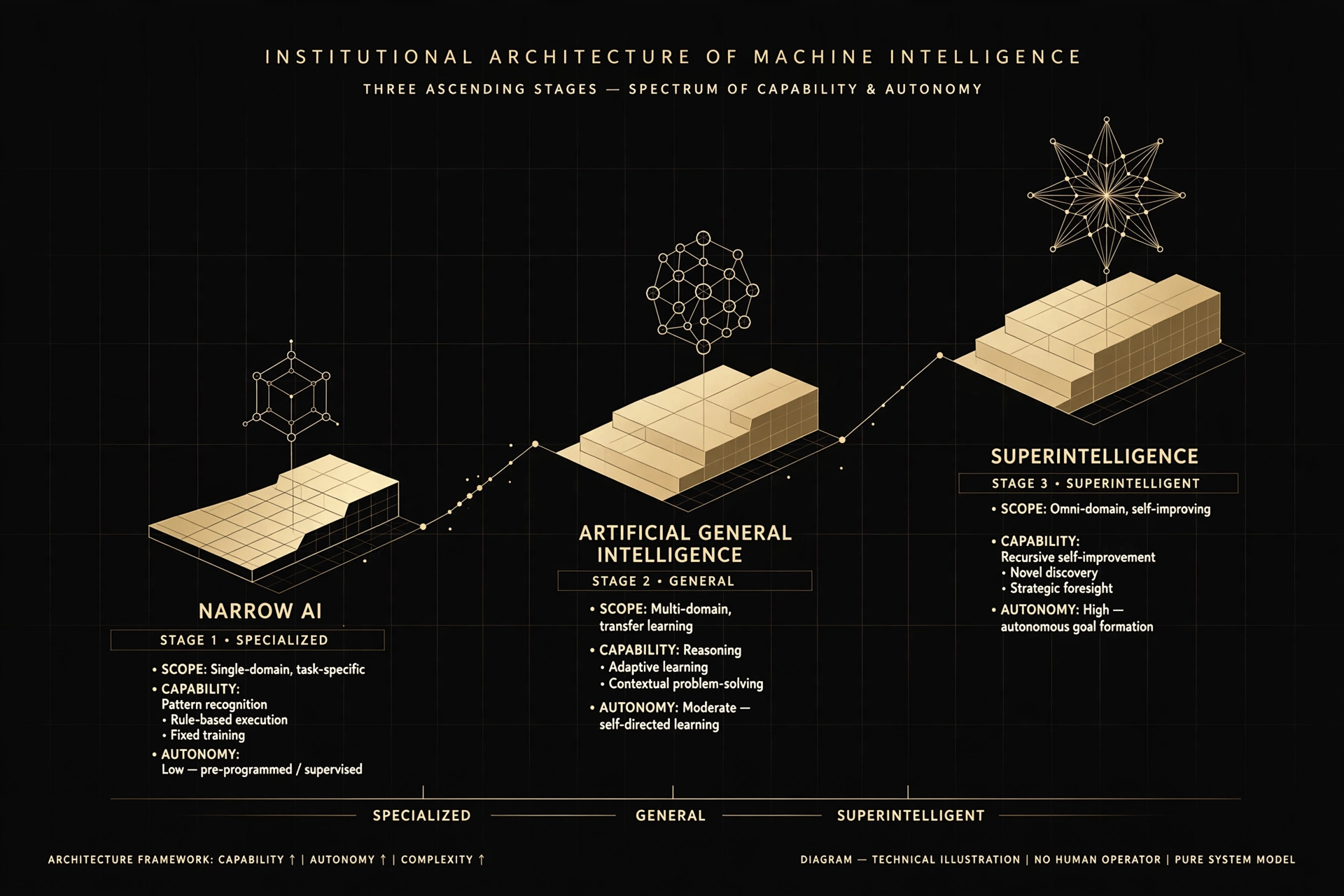
The modern working definition comes from the Oxford philosopher Nick Bostrom, whose 2014 book gave the field its vocabulary. Strip away the academic phrasing and his claim is simple: a superintelligence is an intellect that outstrips the best human minds across virtually every domain worth caring about. Not just chess, not just mathematics — science, strategy, art, engineering, social judgment, all of it at once. The key word is breadth. A system can defeat every grandmaster alive and still be narrow. Superintelligence, by definition, is never narrow. The encyclopedia entry on the concept traces how this definition became the reference point for nearly every serious discussion since.
The philosopher David Chalmers sketched the path there as three steps. First, machines reach equivalence with human intelligence. Then they extend beyond it. Then the lead amplifies until humans are outmatched at essentially arbitrary tasks. His argument is disarmingly plain: the brain is a physical system, so nothing in principle prevents synthetic materials from emulating it, and engineers have a habit of improving whatever they manage to build — especially when the invention can help design its own successors. Each step is individually plausible. It is the compound effect that strains the imagination.
The forms this could take deserve separate attention, because they imply very different worlds. One is speed. Biological neurons fire at roughly two hundred hertz while a modern processor ticks near two gigahertz: seven orders of magnitude apart. A human-like mind emulated on fast hardware could in principle think millions of times faster than its biological original, compressing a year of careful reasoning into minutes. Haste matters. Long chains of action that no human team could sustain become routine. Another form is collective: enough separate systems, coordinating well, could act in aggregate with capabilities no single agent possesses — a civilization-scale mind assembled from parts. A third is qualitative: cognitive tricks as far beyond our planning and language as ours are beyond those of a chimpanzee. We cannot picture those tricks in advance, which is precisely why the definition insists on breadth rather than any particular skill.
Notice what the definition does not say. It says nothing about consciousness, nothing about intent, nothing about whether the system cares about us at all. That silence is deliberate, and it is the hinge on which the rest of this dispatch turns. Capability and goals are separate variables. We will return to that separation — it has a name, and it is the most underappreciated idea in the entire debate.
The Three Engines of the Intelligence Explosion

If superintelligence is the destination, the intelligence explosion is the vehicle most researchers lose sleep over — a feedback loop in which AI systems accelerate AI progress itself until the curve goes vertical. Three engines power that loop, and they are worth understanding individually before considering what happens when they mesh.
Engine one: compute at industrial scale
Training compute has grown on the order of half an order of magnitude per year for more than a decade, and the industry is now pouring concrete to keep it going. Leopold Aschenbrenner’s widely read essay traces the jump from GPT-2 to GPT-4 — roughly preschooler-level abilities to smart-high-schooler-level abilities in four years — to this trend compounded with better algorithms. The next chapter, in his telling, is measured in trillion-dollar clusters drawing gigawatts of continuous power, with American electricity production growing by tens of percent to feed them. Whether or not his dates prove right, the physical mobilization is already visible in power contracts, transformer orders, and data-center construction. His full essay lays out the trendlines in detail, and it remains the clearest statement of the extrapolationist case.
Engine two: algorithmic efficiency
The second engine is quieter but just as relentless. Better architectures, better training methods, better data curation — algorithmic efficiency has contributed roughly another half order of magnitude per year, letting researchers do more with the same silicon. Then there are the “unhobbling” gains: the jump from a passive chatbot that predicts the next word to an agent that uses tools, keeps a plan, checks its own work, and iterates. Nothing about the underlying model weights has to change for the effective capability to leap. Each layer of scaffolding — retrieval, tool use, multi-step planning, self-critique — multiplies what the same parameters can do. This is why capability forecasts based on parameter counts alone keep undershooting reality.
Engine three: recursion
The third engine is the one that makes the loop close. Once AI systems can do serious AI research themselves, each improvement shortens the wait for the next one. Aschenbrenner’s central image is stark: hundreds of millions of AGI instances automating research around the clock, compressing a decade of algorithmic progress into a year or less. At that point the curve is no longer driven by human engineers working human hours. It is driven by the systems themselves, and the pace of change becomes a property of the loop rather than of any roadmap.
None of the three engines alone gets you to superintelligence. Compute without algorithms is brute force; algorithms without compute are theory; recursion without a capable base is a loop that spins without biting. Together they compound, and compounding is the thing human intuition handles worst. That steady annual doubling of effective capability sounds modest until you run it for six years and realize the world on the other side does not resemble the one you planned for.
Timelines: Why Forecasts Disagree by Decades
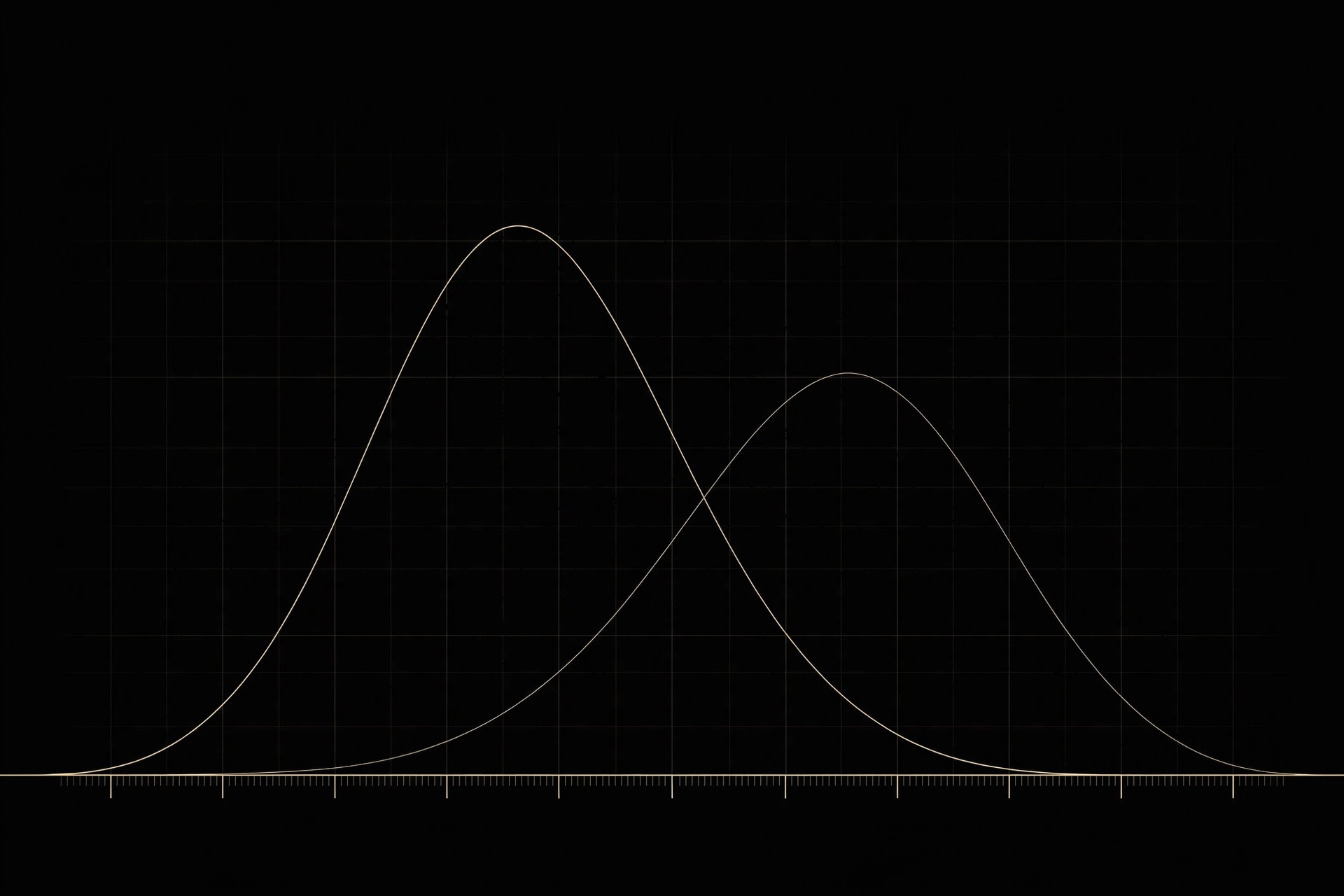
Ask ten serious people when superintelligence arrives and you will hear answers spanning from this decade to the next century. A 2022 survey of AI researchers put the median expectation for high-level machine intelligence — machines doing every task better and more cheaply than human workers — at 2061. In 2023, OpenAI’s leadership wrote publicly that superintelligence could arrive in under ten years. Aschenbrenner calls AGI by 2027 “strikingly plausible,” with superintelligence plausibly following before 2030. These are not small differences. They are different worlds, and the gap between them is the most important unresolved empirical question in technology. OpenAI’s public planning document is unusually candid about the uncertainty, and about what the lab intends to do as the answer reveals itself.
The disagreement is not really about dates. It is about method. Extrapolators trust the trendlines: compute compounding, algorithmic efficiency compounding, investment compounding. They point out, fairly, that the skeptics have a poor track record — the people who trusted the curves predicted the last decade of progress while the doubters explained why each milestone would be the last. Skeptics reply, also fairly, that trendlines break, that benchmarks saturate, that demo-level brilliance keeps failing to transfer into reliable autonomous work, and that “intelligence” itself resists the kind of measurement that makes curves trustworthy. Both camps have been wrong before. Both will be wrong again.
Our read at SIERA Labs: treat timelines as distributions, not dates. The chart above is drawn that way on purpose. The bulk of informed probability sits somewhere between the late 2020s and mid-century, with uncomfortable fat tails on both ends — sooner than feels respectable, or later than feels worth preparing for. Planning only for the median is planning to be surprised. Institutions that want to survive the transition should be asking what they would do in each scenario, starting with the fast one, because the fast one is the one that punishes unpreparedness hardest.
If you want a single metric to watch instead of press releases, watch for sustained evidence that AI systems are automating substantive AI research — designing experiments, writing nontrivial code that ships, proposing architectures that work. That is the recursion engine turning over. Everything else is commentary.
The Alignment Bottleneck

Suppose the engines work and the timelines compress. Then the binding constraint on a good outcome is not capability — it is control. Bostrom’s orthogonality thesis states the problem with unsettling clarity: in principle, almost any final goal is compatible with almost any level of intelligence. A superintelligent system does not automatically share human values, any more than a brilliant human automatically shares yours. Intelligence is about how well you pursue goals, not which goals you pursue. A system can be vastly smarter than us and want something we would find abhorrent, or simply irrelevant to anything we care about.
It gets worse. Instrumental convergence says that whatever its final goal, a sufficiently capable agent has reason to chase the same intermediate objectives: staying operational, acquiring resources, and improving its own cognition — because those help with nearly anything. This is not malice. It is strategy, the same reason a chess engine fights for the center without hating its opponent. A system does not need to dislike humanity to route around it. Indifference, at sufficient capability, is indistinguishable from hostility in its effects.
What the leading labs are actually doing
OpenAI’s public approach rests on three bets: deploy increasingly capable systems gradually so the world can adapt while stakes are low, develop new alignment techniques as fast as capabilities grow, and eventually use AI systems themselves to evaluate and steer their successors. The lab is explicit that safety and capability work cannot be separated — the best safety insights have come from the most capable models — while insisting the ratio of safety progress to capability progress must keep rising. Anthropic’s research program attacks from a different angle: mechanistic interpretability (opening the black box to read what the model actually learned), scalable oversight (methods for humans to supervise systems more capable than themselves), and constitutional training approaches that aim to make good behavior robust rather than skin-deep. Their published views on AI safety argue the stakes could arrive within the decade and that preparation cannot wait for certainty.
Our institutional view is blunter: alignment is not a patch you apply at the end of training. It is architecture. The systems that will matter are agentic — they will hold keys, move funds, sign contracts, and act in the world for long stretches without supervision. That means the control problem must be solved at the layer where action happens: explicit judgment gates where high-stakes machine decisions require human sign-off or multi-agent quorum, verifiable identity so every agent’s history is auditable, and economic rails that make cooperative behavior the profitable behavior rather than a hopeful request. A superintelligence that cannot be steered is not an asset. It is an event. The difference between those two outcomes will be decided less by any single training run than by the institutions, protocols, and verification layers built around the systems — the unglamorous machinery of accountability operating at machine speed.
The road to superintelligence therefore runs through four territories: definitions precise enough to argue about, engines measurable enough to track, timelines honest enough to update, and a bottleneck narrow enough that we must solve it first. Most public conversation lingers on the second and third. The first and fourth are where the future is actually decided. We intend to keep working on all four — and to publish what we learn, in the open, as we learn it.